Thank you!

Lorem Ipsum is simply dummy text of the printing and typesetting industry. Lorem Ipsum has been the industry's standard dummy text ever since the 1500s, when an unknown printer took a galley of type ...

Minimal Design

Lorem Ipsum is simply dummy text of the printing and typesetting industry. Lorem Ipsum has been the industry's standard dummy text ever since the 1500s, when an unknown printer took a galley of type ...

Download high quality wordpress themes at top-wordpress.net

Lorem Ipsum is simply dummy text of the printing and typesetting industry. Lorem Ipsum has been the industry's standard dummy text ever since the 1500s, when an unknown printer took a galley of type ...

Easy to use theme’s admin panel

Lorem Ipsum is simply dummy text of the printing and typesetting industry. Lorem Ipsum has been the industry's standard dummy text ever since the 1500s, when an unknown printer took a galley of type ...

Prev Next

Showing posts with label GreatPerson. Show all posts

A Post Without Image

Samdech Sangha RajaChuon Nat


Samdech Sangha Raja Jhotañano Chuon Nath (March 11, 1883 – September 25, 1969) is the late Supreme Patriarch Kana Mahanikaya of Cambodia. Amongst his achievements is his effort in conservation of the Khmer language in the form of the Khmer dictionary. His protection of Khmer identity and history in the form of the national anthem, Nokor Reach and Savada Khmer are also amongst his contribution to the country.
Conserving the Khmer Language
Nath was the head of a reformist movement in the Khmer Buddhist Sangha which developed a rationalist-scholastic model of Buddhism, rooted in linguistic studies of the Pali Canon. This new movement, known as Dhammayuttika Nikaya, influenced young Khmer monks in the early 20th century. The new movmenet also cultivated Khmer-language identity and culture, giving rise to the notion of Cambodian nationalism.
Nath pushed for a series of innovations in the Khmer Sangha beginning in the early twentieth century: the use of print for sacred texts (rather than traditional methods of hand-inscribing palm-leaf manuscripts); a higher degree of expertise in Pali and Sanskrit studies among monks; a vision of orthodoxy based on teaching of Vinaya texts for both monks and lay-people; and modernization of teaching methods for Buddhist studies.
He also oversaw the translation of the entire Buddhist Pali cannon into Khmer language; and the creation of the Khmer language dictionary.
The French set up its protectorate over Cambodia and intended to replace the Khmer language with its own through the so-called "pseudo-French intellectuals." This intention rallied many Cambodian scholars to the course of conserving the Khmer language; one such scholar was Nath. A son of farmers who later became a monk, Nath dedicated his life to upholding Buddhism and the conservation of Khmer language in the country that was highly influenced by French colonialism. He had an extensive knowledge of the Khmer language. He was probably the most famous and most knowledgeable monk Cambodia had ever had. A master in Buddha’s teaching, he was very well known around the Buddhism circle as well as very adept at languages. Throughout his life he encouraged the use of "Khmerization" in both public education and religions. What Nath meant by "Khmerization" was he wanted to derive new Khmer words from its ancestral roots, the Pali and Sanskrit languages. For example, when the train arrived first in Cambodia, there was no Khmer word for the train. Nath thus derived the word for train from Sanskrit and Pali word of Ayomoyo which means something that is made of metal. Together with the word Yana which means vehicle, came the Khmer word for train which we know today as Ayaksmeyana, pronounced Ayak-smey-yean.
However, Nath’s Khmerization was not overall accepted by all Khmers. ther scholars such as Keng Vannsak who were pro-French did not find the kind of Khmer words derived from Pali and Sanskrit to be convenient. They revolutionized another kind of derivation which they want to adopt normalized French word into Khmer vocabulary. The only major change was to use Khmer alphabet to write the word rather than using the Roman alphabets used by the French. But despite opposition, Nath’s Khmerization succeeded. He was a member of the original committee granted royal order to compile a Khmer dictionary in 1915 and was credited as the founder of the dictionary as he pushed for and finally succeeded in printing the first edition of the current Khmer dictionary in 1967.
Nath’s other contribution to Cambodia include the current national anthem, Nokoreach. Nokoreach was written to correspond to the motto of the nation, "Nation, Religion, King" as well as demonstrate the grandeur and the mighty past of the Khmer nation.
Verification of the national khmer song:
Pong Savada Khmer
A ballad Savada Khmer to call for all Khmer to unite, to remember and to uphold the great history of the Khmer people was written by Mr Nuon Kan on 12/09/1958. It was not written by Samdach Chuon Nath though our Samdach Chuon Nath was giving a lot of support and encouragement to publicize khmer nationalistic nature of this song.
English Translation
All Khmers, please remember the root and history of our great countryOur boundary was wide and well knownOthers always thought highly of our raceAnd always placed our race as the elders.
We have great heritage and cultureWhich has spread far and wide in the Far East.Religion, arts and education,Music, philosophy and strategies are all that we have spread.
All Khmers, please remember our roots and historyWhich speaks of the grandeur of our great raceMake up your mind and body and try hard to rebuildIn order to lift the value of our nationTo once again rise to the greatness that we once had.

A Post Without Image

Krom Ngoy


Krom Ngoy was born Ouk Ou but often has been called Phirum Ngoy or Ngoy the language master. He was a legendary poetry singer, unrivalled in Cambodia, during his times and afterwards. He was considered as the Father of Khmer Poetry because many of his poems, which often described about moral issues, taught people about life, culture, arts, literature and Cambodian nationalism. But above all, the reason that he was known as the Father of Cambodian Poetry was because most, if not all, of his poems were used as guides by many parents to teach their children about the Khmer traditions and culture. His poems rhymed so perfect and when sung in the form of Chapei songs (poetry singing with the singer playing a guitar-like instrument while he/she sings) can messmerise, hypnotise and captivate the audience’s imaginations. He has a unique poetry skill unrivalled in Cambodia of his times and thereafter. Only two other Khmer poets, Suttantaprija Ind and Santhor Mok, came close to his calibre. His many prose and poems,which were usually sung in the forms of Chapei songs, such as the Law for Men and Women and Krom Ngoy’s Will, have been used as guides for many people throughout the country to teach their children about moral issues. Many of his poems, which often aimed at guiding the people about their life, raising their children and about the preservation of the Khmer culture and literature, were used as texts at many Cambodian schools. Krom Ngoy comes to symbolise as a Khmer icon during his time and afterwards. His poems rhymed so perfect. They mesmerise, hypnotise and captivate the audience’s imagination when sung in the forms of the Chapei songs. As he had made a mark in the Cambodian society and in the history of Khmer literature, and being the icon of Khmer poetry, the accounts about the life of this great man must be recorded for all to know.
Krom Ngoy (1865-1936), Family Lineage


Krom Ngoy was born in the Christian era of 1865, the Buddhist era of 2408 in Andong Svay village, Kombol commune, Phnom Penh district, Kandal province. His father, Ouk, was the chief of Kombol commune with the royal title of Chao Ponhea Dharma Thearea ( a royal title for the commune chief during the 19th century). Chao Ponhea Ouk had a family lineage with the Lord Poc who was a descendant of Chaova (Lord) Baen whose descendants ruled as the lord-governors of Batammbang province from 1796 until 1907. His mother’s name was Ieng who was a daughter of Chao Ponhea Poc, the chief of Spean Thmor commune of the same Phnom Penh district. Both his father and mother were the second children in their respective family.
Phirum Ngoy was married to Mrs. In and had six sons. They are 1. Dong, 2. Cheng, 3. Cha, 4. Chen, 5. Chong and, 6.Chev. Among his six sons there was one son who inherited his poetry skills. Chong, the sixth son, had a poetry skills that rivalled his father and was respectfully called Achar Chong by many who knew him (Achar meaning “a learned man”). Phirum Ngoy had one grandson who inherited his poetry skills and became the Ayai singer (Ayai is another form of a duet poetry song performance, often between a man and a woman throwing sarcastic comments at each other while they sing). It was said that this grandson had a very thin build so people who knew him well affectionately nicknamed him Neay Sloek (Mr. Leaf) because he was as thin as a leaf. And when he sang the Ayai song he always introduced himself this eloquent fashion: “My birth village is located west of Pochentong and I am the son of Achar Chong and the grandson of Achar Ngoy”.
Phirum Ngoy passed away on Friday, the sixth day of the Moonrise in the Lunar calendar, the 12th month of the Buddhist era of 2479, the Christian era of 1936 at the age of 71 years old, due to constipation.
Krom Ngoy’s Education
When Krom Ngoy was a young boy he studied arithmetic and literature at Boeng Chork Temple in Baek Skor village, Baek Chan commune, in his native district. He excelled in literature and poetry. Krom Ngoy was a very studious child. During his childhood he had been ordained as a Buddhist novice in the village temple. After a few years spent as a novice he left a monastic life in order to help for his parents in the farm. He also served as a secretary to his father and as a tax collector for the royal treasury. At 21 years of age he was once again ordained, this time as a senior monk, in his old temple under the guidance of Mr. Sass, Venerable Chrouk and Venerable Oung as his religious teachers. Venerable Krom Ngoy learned about the Buddhist teachings, the Pali language and learned how to translate the Buddhist Scripture, The Tripitaka, first under the guidance of Venerable Tith, a high priest of Ang Boeng Chork Temple. After he gained enough knowledge he changed course and went to practise Vipassana (meditation) with many religious teachers in various places. This time he remained in the monkhood for 5 years. After obtaining enough religious knowledge he decided to leave the monkhood and become a lay-person. He then returned to work for his father as both his legal advisor and as his secretary. When Cambodia was facing economic strife and political turmoil he quit his government job and returned to the life of an ordinary farmer. Krom Ngoy was a talented poet who has the ability to remember many ancient stories, both religious and non-religious. He was both a talented musician and a talented singer who can beautifully sing and skilfully play the Ksedeav (the guitar-like instrument) at the same time. He usually sang his poems, in the form of Chapei songs, at various religious ceremonies and festivals. The villagers,who were hypnotised by his poetic Chapei songs, considered him as a scholar. They often called him “Phirum Ngoy”, Ngoy the language master. Krom Ngoy, was a big man with firm build and bulging belly who liked to have his hair cut short and growing his moustache. He often wore a Chorng Kben skirt (a kin of Cambodian traditional skirt), wore a round-necked shirt with big buttons, wore thongs and wore a bird’s nest-like hat. Like many of his contemporaries of that time, he was often bring his walking stick with him and carrying his bag hanging from his shoulder wherever he went. When he sang his Chapei songs he always play the Ksedeav (guitar-like instrument) along as well. His Ksedeav was unique. It can be disassemble at any time and re-assemble as quickly as possible when he needed to play it. It was made from a gourd shell and his walking stick. It was said that when he need to sing his Chapei songs he will take out a gourd shell from his bag, join it with his walking stick, attach the strings from the gourd shell to one end of his walking stick to build an instant guitar to produce a very nice sound. It was said that, in Winter, after he finished with his farm works, he was always invited by villagers from near and afar sing or chant for their festivals or ceremonial events. There were claimed that he never charged the people for his performances. And because they loved him and his performances they always collected the money and the rice from the villagers to give to him. Whenever he travelled somewhere through Phnom Penh he always stayed at the Ounnalom Temple, which was the headquarter of the Cambodian Buddhist Patriarch, in order to use the opportunity to discuss about various religious issues with the senior Buddhist monks there.
Krom Ngoy’s Poetry Works


Krom Ngoy’s songs or religious chants always described about the current issues of his time. His poetry and Chapei songs described about issues related to farming life, about the ethics of Khmer traditional marriage life, about poverty and its reasons and causes, about the lack of education and the illiteracy of the Khmer people, about divisions and conflicts in the Cambodian society, about foreign repression and oppression of the Khmer people, about the lack of Khmer independence and about the survival of the Khmer culture and Khmer literature as a whole.
Becoming a Royal Singer
Krom Ngoy’s reputation as a talented poet has spread to the king of Cambodia. His Majesty King Sisowath instructed his court officials to invite Krom Ngoy to come to sing for him in the Royal Palace. Krom Ngoy had performed numerous times for ordinary folks. But this is the first time in his life that come to perform for the Khmer king. He was not sure how his performances will impress the king or will they bore the king. However, during his Chapei performances at the royal palace he impressed the king with his eloquent and poetic Chapei songs. Impressed by Krom Ngoy's Chapei performances, King Sisowath invited Ngoy to join the Royal Band and presented him with the royal title of “Ou, the language master”, Ou being his birth name. But because there was someone in the Royal Band was named Ou already His Majesty instructed everyone to call him “Ngoy” instead, so as not to be confused with the other Ou. Since then he was called Ngoy or Krom Ngoy (Ngoy, the expert).
Performing for the Thai King
Ngoy’s reputation as a skilful poetry singer was not confined in within Cambodia alone. His reputation has rapidly spread to the Kingdom of Thailand as well. By chance or by pre-arrangement, one day the Siamese prince named Dhamrong Rajanubharp and a French man named (Georges?) Coedes had an audience with King Sisowath. During the musical performances for the two foreign guests in the royal palace Krom Ngoy had outperformed the other musicians with his Chapei songs by playing the Ksedeav along. He had captivated the Thai prince’s imaginations with his poetry skills. The Siamese prince, upon his return to Thailand informed the Thai king of Krom Ngoy‘s hypnotising Chapei performances. The Thai King then sent a royal letter to the Khmer King asking for a royal permission to invite Krom Ngoy to sing for him in Bangkok. Krom Ngoy went to perform in Thailand for three months and received a cordial royal reception from the Thai King and his officials. Krom Ngoy again impressed the Thai king with his poetic Chapei songs. After many performances in the Thai royal palace, the Thai King then presented him with a title as a master of the “phai roh leou kern” (the master of the melodious voice). The Thai king's gesture was unprecented as no other Khmer had ever received such title before. The Thai King also presented him with silver buttons, money and other paraphernalia for his brilliant poetry singings. After the performances for the Thai king, Krom Ngoy returned to Cambodia through Battambang and he met another skilful poetry singer named Phirum Yu, Yu the language master. Phirum Yu had heard that Phirum Ngoy was a skilful poetry singer so he asked Phirum Ngoy for a duet. During the duet Phirum Ngoy outperformed and outsmarted Phirum Yu with his poetry skills. In the song Pirum Yu asked Phirum Ngoy many questions about Meru Mountain. Not to be outsmarted by Phirum Yu, Phirum Ngoy replied “if you are so curious like this, do you want me to tell you the truth or do you want me to lie?” Phirum Yu retorted that “I asked in a bona fide therefore you, Phirum Ngoy, must answer in bona fide“. Phirum Ngoy answered Phirum Yu’s questions by describing about Mount Meru in his masterly poetry form and sarcastically retorted that if Phirun Yu did not believe him he must go and see it for himself. Phirum Yu accepted Phirum Ngoy’s answers. Now, it’s Phirum Ngoy’s turn to ask Phirum Yu. Phirum Ngoy asked Phirum Yu “ how far is Battambang Market from Phnom Penh if one travels by road? And how many kilometres if one travels by way of Tonle Sap river?” Phirum Yu cannot answer Phirum Ngoy‘s questions. Phirum Ngoy then sang by throwing critical sarcastic comments at Phirum Yu that “a place and a country where you used to live, you cannot answer me. And you asked me a place where I had never been to. Even if I lied to you, you wouldn’t know if I lied or not.” Phirum Ngoy continued to throw critical sarcastic comments at Phirum Yu until he felt so embarrassed and walked off the stage. The audience enjoyed the poetic exchanges and cheered for Phirum Ngoy when Phirum Yu walked off the stage. After the poetic exchanges, the governor of Battambang presented Phirum Ngoy with winning trophies of one white horse and 400 riels in cash (a huge sum at that time). Since then many prose singers were afraid to sing in a competition with him. Only a village chief named Sann of Pleung Chhess Rotess commune, Phnom Penh district, who was his very good friend and his usual duet, who can face up to his poetic skills. He and his friend always went to sing in a duet together. Wherever these two went to sing people, old and young, from near and afar came in their big crowd to listen to them sing.
The Publications of Krom Ngoy’s Poetry


For a while, after his return from Thailand, Mr. (Georges?) Coedes introduced Phirum Ngoy to Miss Suzanne Karpeles, who was the director of the Buddhist Institute in Phnom Penh. In 1930 Miss Suzanne Karpeles invited Phirum Ngoy to sing all his poetry songs again so that the scholars at the Buddhist Institute can record and publish his works in books. As a reward Miss Karpeles gave Phirum Ngoy 1 riels in cash as a token and symbol of his love for, and service to, the Khmer culture and literature. His poetry masterpieces were then published into four books and later combined them into only one book by the Buddhist Institute. Phirm Ngoy had written many poems, far more than were published by the Buddhist Institute because all of his poems and poetry songs were verbally authored and memorised and were never written on papers. His masterpieces which we had found in books to this present day are: 1. Chbab Laboek Thmey, the law of the new prose- a ballad of four rhyming words which was published in 1922. 2. Chbab Kekal Thmey, the law of the new inheritance- a poem of 4, 5 and 6 rhyming words which was published in 1922. 3. The Advice on Life, a poem of 7 rhyming words which was published in 1931. 4. Chbab Bross Chbab Srey, The Law for Men and Women, a poem of 7 rhyming words, published dates were unknown. 5. Bandam Krom Ngoy, Krom Ngoy’s Will- a poem of 7 rhyming words, no dates of publication were known.
Krom Ngoy's Legacy


Krom Ngoy had authored many unpublished literary works. Up until these days many of his literary works were still not been properly documented and archived yet. As a result, many of his works were lost. For example, many of past literary works were hand-copied from one person to another and the authors’ names were omitted. As a result, there were many other literary works by unnamed Cambodian past writers, which were discovered by later day scholars, were not attributed to any writers . The titles such as The Gratitude, The Three Attributes, The Law for Men and Women were published anonymously. Later days scholars were unable to determine who the authors were. But after some research and comparisons, they considered those literary works to be the works of Phirum Ngoy. Krom Ngoy had left many great literary legacy that rivalled the works of many great Western writers. His literary works, which often described, and aimed at educating people, about ethics and moral issues, were used as manuals to guide many Khmer families and parents in teaching their children about life and moral issues. Many of his literary works were used as texts in many Cambodian schools. His literary works were masterpieces and will be irreplaceable. It is therefore imperative that the next generations do everything possible to preserve his priceless works.

A Post Without Image

Family of Prime Minister Hun san


Hun Sen is married to Bun Rany. They have six children, 3 sons and 3 daughters: Manet, Mana, Manit, Mani, Mali, and Malis. The youngest, Malis was adopted. Hun Manet is a 1999 West Point Academy graduate and is pursuing his PhD in economics at the University of Cambridge in England[citation needed].

In October 2007, Hun Sen made a surprise announcement at a graduation ceremony in front of an audience of around 3,000 that his adopted daughter is a lesbian. He has taken legal steps to disown his daughter and to prevent her from receiving any inheritance. Nonetheless, he asked the audience to accept homosexuals.

Although Hun Sen's birthday is officially celebrated as April 4, 1951, he has revealed that his actual date of birth was August 5, 1952.[9] He apparently lied his date of birth to appear older when joining the Khmer Rouge as a yout

A Post Without Image

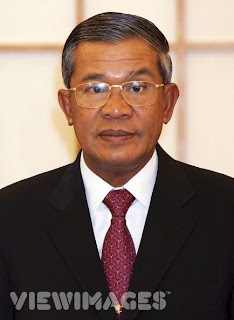
Prime Minister Hunsan In Cambodia


Hun Sen (born August 5, 1952; officially on April 4, 1951) is the Prime Minister of Cambodia.

He is one of the key leaders of the Cambodian People's Party (CPP), which has governed Cambodia since the Vietnamese-backed overthrow of the Khmer Rouge in 1979. He was a former Khmer Rouge who escaped to Vietnam before 1979 in order to call the Vietnamese to overthrow the other Khmer Rouge. Since the restoration of multi-party democracy in 1993, the CPP has been in coalition with the royalist Funcinpec party and as senior partner since 1997.

His current, full, honorary title is: Samdach Akkak Moha Sena Padey Dekjo Hun Sen. The title "Samdech" was attached to his name in 1993 by King Norodom Sihanouk. It is only an honorary title and does not give him further powers. He has a glass eye, the result of a wound sustained during the Khmer Rouge offensive against Phnom Penh in April 1975.

Hun Sen was selected by the Vietnamese for a leadership role in the rebel army and government they were creating for Cambodia. When the Khmer Rouge regime was overthrown, Hun Sen was appointed as foreign minister of the Vietnamese-installed People's Republic of Kampuchea/State of Cambodia (PRK/SOC) in 1979 and in 1985 he was made Chief of the Minister Council, prime minister, after the death of his chairman Chan Sy until 1990, with a brief interruption from 1986 until 1987. As foreign minister, Hun Sen was a key figure in the Paris Peace Talks which brokered peace in Cambodia.

From 1993 until 1998 he was co-prime minister with Prince Norodom Ranariddh. Norodom Ranariddh was First Primer Minister and he was second Prime Minister. However, the actual power lied in the hand of Hun Sen for most of the high officers in Cambodia including the military are CPP members which led Norodom Ranariddh to be jealous of his co-prime minister and led to power struggle and directly resulting in the July 1997 military conflict.

In 1997, the coalition was shaken by tensions between Ranariddh and Hun Sen. Funcinpec began to collaborate with the remaining Khmer Rouge rebels (with whom it had been allied against Hun Sen's Vietnamese-backed government during the 1980s), aiming to absorb them into its ranks.

In response, Hun Sen launched the 1997 Cambodian Coup, replacing Ranariddh with Ung Hout as the First Prime Minister and himself still as the Second Prime Minister until his CPP party victory in 1998 election and becoming the country's sole prime minister in 1998. During that year the media has broadcaste him as the Strong Man of Cambodia which he later said it was too early and that the July 1997 merely an event that the government took action against the anarchy paramilitary that sponsored and brough to Phnom Penh by Norodom Ranariddh. It was not a coup after all.

The elections of July 2003 resulted in a larger majority in the National Assembly for the CPP, with FUNCINPEC losing seats to the CPP and the Sam Rainsy Party.However, CPP's majority was short of the two thirds constitutionally required for the CPP to form a government alone. This deadlock was overcome and a new CPP-FUNCINPEC coalition was formed in mid-2004. When Norodom Ranariddh was chosen to be the head of National Assembly and Hun Sen become again sole prime minister of Cambodia.

He joined the International Parliament for Safety and Peace, as Senator for Life in October 2007.

Some political opponents of Hun Sen accuse him of being a puppet of Hanoi. This is due to his position in the government created by Vietnam while Cambodia was under Vietnamese military occupation and the fact that he was a prominent figure in the People's Revolutionary Party of Kampuchea (now known as the Cambodian People's Party), which governed Cambodia as a one-party state under Vietnamese military occupation from 1979 until the elections in 1993. Hun Sen and his supporters reject such charges, saying that he represents only the Cambodian people. More recent political opponents outside the country know him, his family and CPP for being a corrupt dictator who controls the country by force.[citation needed]

Hun Sen's government has also been known for carrying out a fire sale of land to foreign investors in 2007-08 and the eviction of thousands of residents from their homes.

Hun Sen was implicated in corruption related to Cambodia's oil wealth and mineral resources in Global Witness 2009 report on Cambodia. He and his close associates were accused of carrying out secret negotiations with interested private parties and taking money from those who he would grant rights to exploit the resources. However, the prime minister and his government have denied this accusation and called it groundless.[citation needed]